
Close
Call for Additional Information
(915) 593-5676
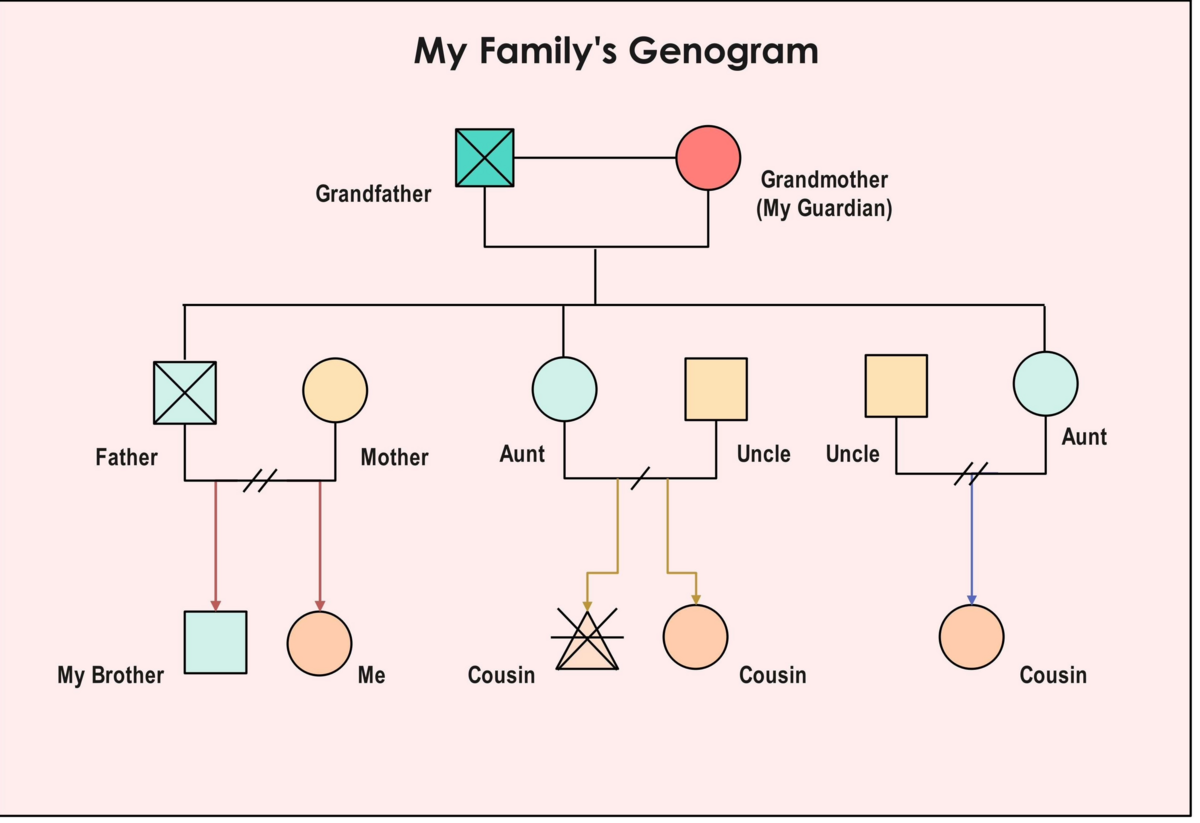
Genograms are visual representations of genealogy, similar to a family tree. Genogram is a tool used to track family history and relationships. It offers a detailed pictorial display of a family or group that goes beyond a simple family tree, including information on various types of relationships—both familial and non-familial. Genogram maps intergenerational family connections to show patterns across families and generations, providing a broad overview (Majhi et al., 2018). Genograms can represent various information, such as gender, age, ethnic origin, health status, educational achievements, and different types of relationships, such as family, social, and emotional connections. They also display, through pictorial forms, the three or more generations’ information, sources of stressors, and available resources (Kennedy, 2010).
The purpose of drawing a genogram is to map out the complex interpersonal relationships present in the family and their biopsychosocial environment. It is a standard tool to assess the composition and structure of a person’s family background, roles, patterns of communication, social interactions, and relationships with the environment. This tool helps mental health professionals recognize visual representations of individuals, families, and hereditary disorders through specific coding or symbols in snapshot observations. Health therapists, clinicians, and others in various fields use genograms to track family history and identify recurring patterns of illness and behavior that affect relationships. This tool helps therapists quickly identify visual representations of the individual, family, and disorders within the family through specific coding or symbols. These symbols include graphical shapes such as circles, rectangles, dotted lines, straight lines, and vertical lines. Therapists use family patterns and constellations to address personal challenges. Assessing family patterns and constellations is essential for therapists for several reasons: To better serve clients, it is crucial to understand the family dynamics and patterns to gain insights into underlying issues that may be affecting the client’s current behavior and relationships. Therapists can provide relatively objective perspectives on family dynamics. They can identify unhealthy patterns and assist individuals and families in breaking them.
Family patterns consist of behaviors, beliefs, and family dynamics that are passed down through generations. These patterns help people understand how past family experiences influence their current behaviors and relationships. Family patterns become deeply rooted within family systems. They include belief systems such as anxieties, expectations, and assumptions, which are then repeated in the new family system. When individuals become aware of how they were programmed and the changes they want to make within themselves, they can create powerful shifts in both their personal and family patterns. Family constellations is a holistic healing modality that enables people to address personal challenges rooted in their past and family history. The more information clients gather about their past, the better they understand what influenced their behaviors and recognize patterns. Personal challenges often turn out to be logical results of a person’s upbringing and the events surrounding their parents’ upbringing, their grandparents’ upbringing, or their broader family history. Family constellation of parent-child relationships within families can have implications for people’s psychological well-being (Kim et al., 2020).
Understanding family constellations helps people uncover, understand, and resolve relationship issues. It can aid in healing relationships by reframing family dynamics and viewing them from a new perspective. Recognizing patterns and constellations enables therapists to work with clients to establish new, positive patterns. This can improve mental health outcomes. By understanding family patterns and constellations, therapists can collaborate with clients to rewrite parental stories, releasing unaddressed suffering and deep-rooted ancestral pain. Additionally, understanding these patterns allows therapists to help clients prepare for potential future challenges.
References
Kennedy, V. (2010). Genograms. MAI Review, 3, 1–12.
Kim, K., Birditt, K. S., Zarit, S. H., & Fingerman, K. L. (2020). Typology of parent–child ties within families: Associations with psychological well-being. Journal of Family Psychology, 34(4), 448–458.
Majhi, G., Reddy, S., & Muralidhar, D. (2018). The use of family genogram in psychiatric social work practice. Open Journal of Psychiatry & Allied Sciences, 9(2), 98–102.